Accéder au contenu principal

Tritones#1 : what is a tritone ?

One octave is 6 tones wide. So, if you split the octave in two , you get an interval of tritone. A tritone is 3 tones wide.
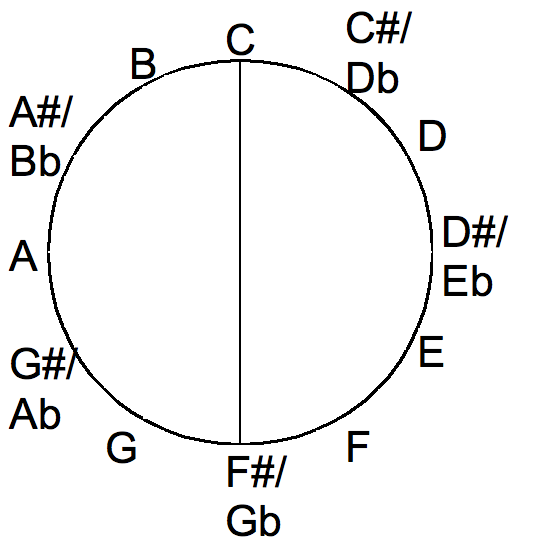
https://commons.wikimedia.org/wiki/File:Tritone_in_the_chromatic_circle.png

If you arrange the notes on the circle of fourths or fifths, and you pick for instance C, the interval of tritones gets you the F#. On the circle, F# and C are opposite. C and F# are said antipolar. It is also the case of D and Ab, B and F, etc...

Let's unroll the C major scale and the F# major scale

The C major scale is :

C D E F G A B 

1 -1 2 2'' -2 3'' -3 4

The F# major scale is :

F# Ab Bb B C# Eb F F# 

2' 3''' 3' 3 4' 4° -5 5°

If you assemble the notes of each scale, you get the chromatic scale, that is, all the notes : the twelve notes

C C# D Eb E F F# G Ab A Bb B

 Some musicians were interested in the properties of the tritone because of its symmetric properties. For instance, Nicolas Slonimsky used it as a mirror by which transposing the notes on each side, as if it was a "virtual" musical plane, and eaqually dispatch the intervals symmetrically above or below.

https://commons.wikimedia.org/wiki/File:Nicolas_Slonimsky.JPG?uselang=fr

There's also some theory around the symmetric properties of Dominant chords because they integrate a tritone : for instance, G7 embeds a B and F, which are 3 tones apart. That's what makes this chord tensed and interesting, furthermore often enriched with alterations.

Later, we'll explore some harmonica licks that use tritones and we will put them into context.

Commentaires

Posts les plus consultés de ce blog

SSCH-56#1 : Exploring the SSCH-56 Suzuki Chord Harmonica

 These times, I'm exploring my SSCH-56 Suzuki Chord Harmonica SSCH-56 Suzuki Chord Harmonica is a very interesting instrument, kind of hybrid between a chromatic harmonica and a chord harmonica. It enables you to play major, minor, diminished and augmented chords. Layout The harmonica layout is the following : There are markings on the top of the instrument to identify major chords and minor chords : I materialized them by the black stripes on the above tablature. Some chords For instance, here is C major : Here is D minor : Diminished chords are on the second hole of the Major block. For instance, here is A semi-diminished chord or Am7b5 or A Ø  : You might meet this chord on a minor 2 5 1 (or II V I) chord in G. Augmented chords are on the second hole of the Minor block. It might seem strange to get this configuration because we could expect the diminished chord to be on the Minor block, and the augmented chord on the Major block : diminished is in fact "very minor" bec...

Howard Levy's solo on Body and Soul transcription

Today, I transcribed Howard Levy's solo on Body and Soul. He played this tune in Konsantin Reinfeld, demonstrating what improving would sound like on different harmonica keys, the last one being Bb harmonica. I personally play only on Bb harmonicas, so I was only interested in this part (https://www.youtube.com/watch?v=X_DDBgcEViw&t=5141s). You'll find the complete transcription of HL Bb harmonica solo on Body and Soul with some annotations (scales, arpeggios,...) in this file : https://docs.google.com/spreadsheets/d/1AD6BTqq-H0n4vS6xRsAC1g5dUJwHNsre5bVhTSZh1MU/edit?usp=sharing On the right, you'll find the minutes to help navigate in the video. You can slow down the video with Youtube video settings. Body and Soul is minor tune, which navigates in many keys. Actually, the version played by HL is an arrangement, incorporating Coltrane changes in the bridge (these changes compose Giant Steps). In future articles, we'll analyze HL solo, some of its characteristic lic...